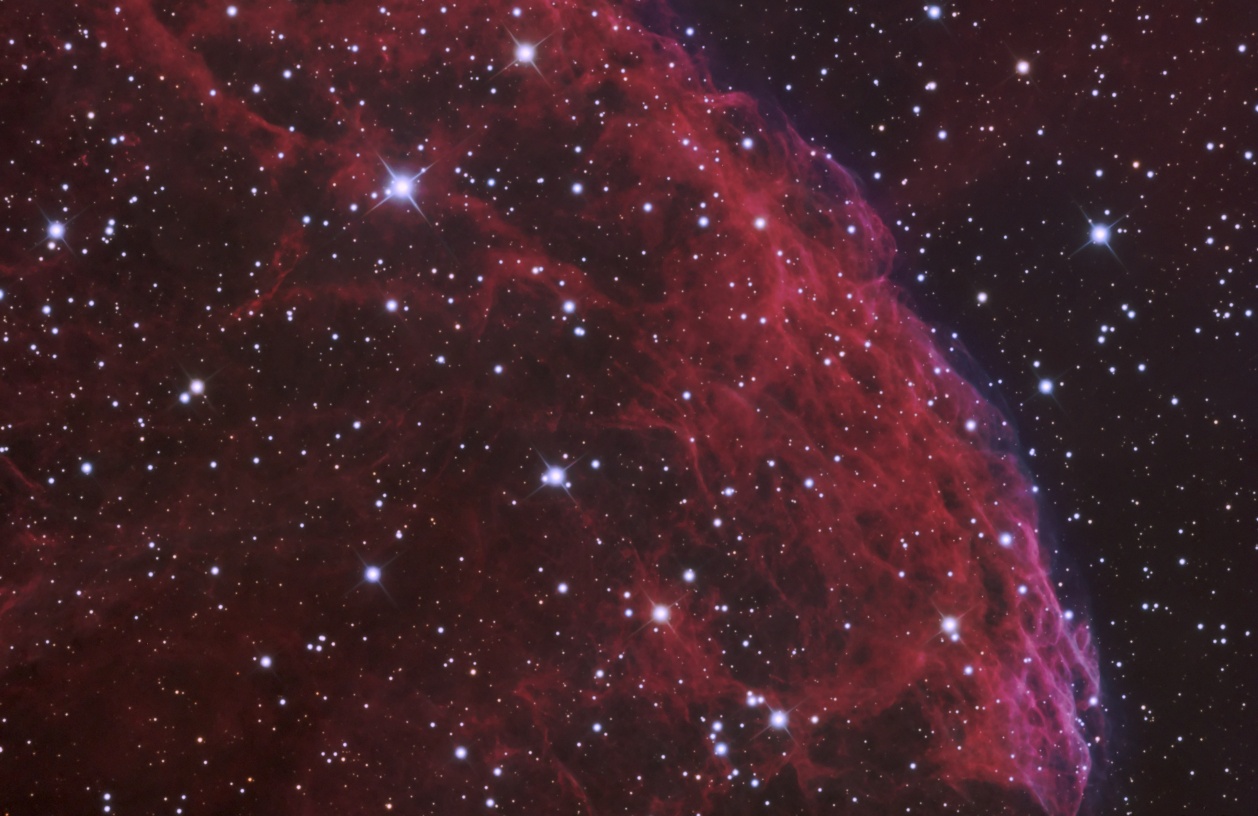
This nebula is the remnant of a supernova that exploded about 8,000 years ago. This is an expanding shell of gas that includes filaments where an existing molecular cloud is being impacted by the shockwave from the explosion. Molecular hydrogen excited by the shockwave produces a glowing red emission that is visible in this image. This supernova remnant also glows brightly in x-rays. When a star explodes like this, the expanding gas shell spreads heavy elements into adjacent molecular clouds which were produced by nuclear synthesis in the star. In addition, the shockwave may set off the gravitational collapse of gas and dust in a molecular cloud resulting in new star formation. Consequently, subsequent generations of stars include elements heavier than hydrogen and helium that are available to form planets orbiting those stars. The death of stars in dramatic supernova explosions is part of the natural evolution of the universe, and provides heavy elements that eventually become involved in the birth of new stars. Iron, carbon, oxygen, gold, and most of the other elements found on our planet Earth were formed in stars that lived and died long before our Sun was born. In reality, our planet and virtually everything on it, including us, are all made of stardust.
The progenitor star was likely as massive O-type or B-type star that lived only a relatively short time before it collapsed and blew itself apart. A neutron star is located near the apex of the nebula. This, plus the location of the supernova remnant near a star-forming region suggest that a Type II supernova formed this nebula. A larger shell-like supernova remnant in the same area was once thought to be part of IC 443, but is now recognized as a different and older supernova remnant called G189.6+3.3. IC 443 is also known as the Jellyfish Nebula.
Click on the above image (or click here) to see a larger version of the image.
This is an LRGB color composite CCD image taken with an SBIG STL-11000M CCD and a RCOS 24-inch telescope. The image was taken at the University of Arizona Mount Lemmon SkyCenter.
IC 443
Constellation: Gemini
RA: 06h 17m 49s Dec: +22d 49' 01" (J2000)
November 21 & 22, 2009
Image by Sid Leach and Adam Block
Mount Lemmon, Arizona
Recent Images.
Complete list of images.
Description of equipment used to acquire images.
Home
Feedback and comments should go to Sid